top of page

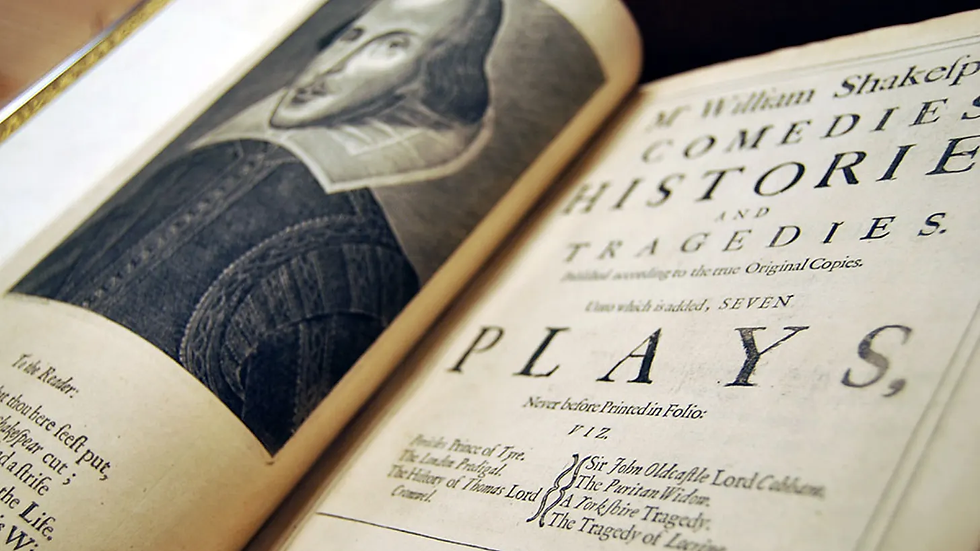
After much thought, I have decided that my next course will be on Shakespeare’s so-called “Late Romances,” a group of plays given to magic, visions, and all savoring of myth and fairytale. It’s the kind of course I would like to have offered as a graduate seminar, but graduate-level humanities are currently in hospice, so I figured I'd give it a crack online.


The plays are really extraordinary in the Shakespearean canon: all, in one way or another, circle around notions of family: of betrayal, of rash words, of wandering the wastes in despair, but also of restoration, forgiveness, renewal, and, most of all, love.


But wait! There’s more! I also want to throw in The Merry Wives of Windsor, a play written at Royal Command because Elizabeth I loved the rascally reprobate Sir John Falstaff so much. Rarely is this play taught or performed—but I love it. And it’s full of folklore farce!


The plays in question (and in order) are as follows:


Pericles, Price of Tyre (c. 1603)


Cymbeline (c. 1608)


The Winter’s Tale (c.1609)


The Merry Wives of Windsor (c. 1602)


The Tempest (c. 1611)


Two Noble Kinsman (c. 1612)


All you need is decent edition of The Collected Works (lots of good ones from which to choose) and you’ll have all you need. The course will be IN REAL TIME, meeting every Saturday at 1:00 pm (Eastern US Time) starting August 2nd (the day after Lammas, for those who celebrate). The course runs for six weeks, and each session will run between 90 minutes and 2 hours and will be recorded for those who might miss a session. The cost for the course is $150 (USD). To enroll, just email me at director@thecenterforsophiologicalstudies.com and I’ll tell you what to do.


Here is a tune I wrote to Shakespeare’s lyrics from Twelfth Night and recorded with me mates The Corktown Popes some years ago (and check out Alan Jackson’s fiddle player, Ryan Joseph, on that fiddle!:


  • Writer: Michael Martin
    Michael Martin
  • Dec 4, 2025
  • 2 min read

Thanks to a nudge from my dear friend Shari Suter, I will be offering a Hedge School course on Pavel Florensky’s The Pillar and Ground of the Truth starting January 10, 2026.


Florensky’s book is one of the most singular works of mystical theology/religious philosophy ever written its structure deeply influenced Valentin Tomberg’s Meditations on the Tarot.


Florensky, who is often called “the Russian Davinci,” was a Russian Orthodox priest and close friend of Sergei Bugakov. Florensky, along with Bulgakov and their spiritual godfather Vladimir Solovyov among others (Nikolai Berdyaev, Andrei Bely, Tomberg, etc) was central to the development of Sophiology in the twentieth century. This did not endear him to either the Bolsheviks or the more reactionary quarters of the Russian Orthodox hierarchy. In such a milieu, Bulgakov, thankfully, was exiled to France. Florensky was not so fortunate, as he was too valuable to the Bolsheviks and the implementation of the new electrical grid for the fledgling Communist nation (among many other talents, Florensky was an accomplished electrical engineer). Once his usefulness was no longer needed, Florensky was sent to the gulag and quickly executed. It probably didn’t help that he attended all official government meetings in his priestly cassock. Florensky, despite what some might call his heretical Sophiology, is regarded a neomartyr in the Russian Orthodox Church, though he has not to my knowledged been recognized as a saint. But that’s their opinion!


In my book Meditations in Times of Wonder, I have poem entitled “Martyrology,” the last stanza of which is about Fr. Pavel:


Mostly it is seen in the blue of the stars and in the Virgin’s eyes, for

Everything is this: the appearance of the beautiful, a kind of radiance.

The blue of the winter sky over Toksovo when the prisoners

Defied the guards and prayed…the blue of his eyes like shards of Armenian

Ice…the blue of the bullet that opened his skull and filled his body with light.


The course will be in real time every Saturday starting at 1:00 pm Eastern US time, January 10, and each session will last for about 90 minutes. The course will last for twelve weeks and end on March 12. All sessions will be recorded on Zoom and be stored and made available to participants in case they miss a session or want to revisit. Cost for the course is $175 and payment can be made via check or Venmo. I also have alternative payment options available for participants outside of the US.


You can catch a brief introduction to The Pillar and Ground of Truth in the video below starting at 28:15.


I give you the end of a golden string;

Only wind it into a ball,

It will lead you in at Heaven’s gate,

Built in Jerusalem’s wall.


I am absolutely thrilled to announce that I will be offering an online, in-real-time course on William Blake’s illuminated book Jerusalem: The Emanation of the Giant Albion. I’ve been wanting to do this for a LONG time, and this seems an opportune moment.


The course will take place over eight consecutive Saturdays at 1:00 pm Eastern US time. It will begin on March 1, the Saturday before Lent begins (for both Western and Eastern Christians for a change) and end on Holy Saturday, April 19. Each session is recorded, so if participants have to miss a Saturday, all will not be lost.


Jerusalem is a story of fallenness and redemption, of human spiritual psychology, and of the power of the imagination. It has been called, among other things, “The Everlasting Gospel,” “The Gospel of the Imagination,” and “Blake’s Apocalypse,” for it is nothing less than a revelation. I have been studying the book since my early twenties, and every time I return to it I am blown away at the depth of insight and organic Christian intuition that shines through every line. I am not exaggerating when I say that it is at times breath-taking.

Jerusalem is composed of four books and in the course we will take two weeks for each book (it’s that dense and profound).


The cost of the course is $150. You can find out more by responding to this newsletter or emailing me: director@thecenterforsophiologicalstudies.com


Recommended editions

My favorite edition of Blake is David Erdman’s The Complete Poetry and Prose of William Blake (University of California Press). The commentary, by Harold Bloom, is enormously insightful as well as edifying.


I also adore the facsimile edition of Jerusalem published by The Blake Trust/Princeton University Press. My working text is the Erdman, though—I’d hate to mar the beauty of the facsimile with my marginalia!


I’m sure there are other good ones out there, but these are my go-tos and very trusty friends.


Young William Blake’s vision of a tree filled with angels


The Center for Sophiological Studies

8780 Moeckel Road  Grass Lake, MI 49240 USA

email: Director

bottom of page